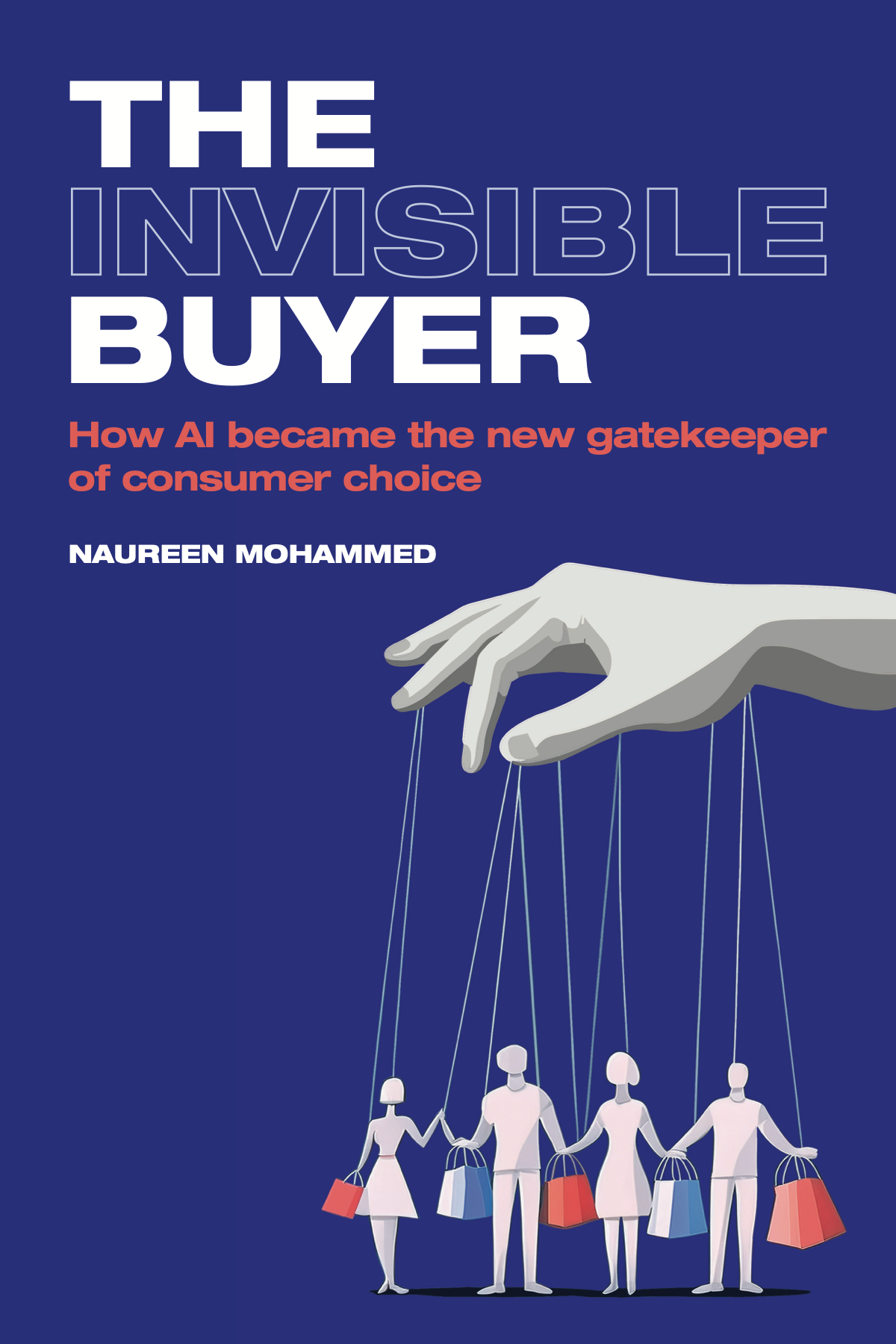
The Invisible Buyer
How AI became the new gatekeeper of consumer choice, and how brands get chosen and bought.
By Naureen Mohammed
Read the research behind the book
For decades your brand had one path to the shopper, guarded by a buyer you know well: the trade buyer at Tesco or Boots, who decides what makes the shelf. AI has opened a second path, guarded by a buyer you have never met.
I call it the Invisible Buyer. It is a machine: the AI assistants your shopper now asks, and the models and recommendation systems behind them. It sits between your brand and your shopper and filters the category before a human ever sees it. Like the trade buyer, it has its own criteria for who gets through. It has not replaced the trade buyer; the two run in parallel, and almost no brand has ever pitched the new one.
It shrinks a category of hundreds of brands to a shortlist of three and recommends one. It cannot be phoned, pitched to or paid. The only currency it accepts is evidence, and that makes this a marketing problem, not a technology one.
Being found is not the same as being chosen.
The evidence is my own research programme, the AI Choice Audit: 6,000 data points on how AI assistants recommend brands across UK consumer categories, gathered month by month. The same pattern turns up in category after category: a household name makes the shortlist constantly and is never the pick.
It does not stop at the diagnosis. Three jobs: get found, get chosen, get bought. GEO gets you found, marketing gets you chosen, your commercial team gets you bought. Then a simple ninety-day plan: audit where you stand, fix what you can, build proof on a handful of questions, and measure again.
I wrote it for the marketing leaders who can see their brand missing from the answer and have no framework to explain why, and for the boards asking them about it. It draws on thirty years on both sides of the table: building brands at Unilever, Beiersdorf and Johnson & Johnson, then a decade inside Meta and Pinterest.